
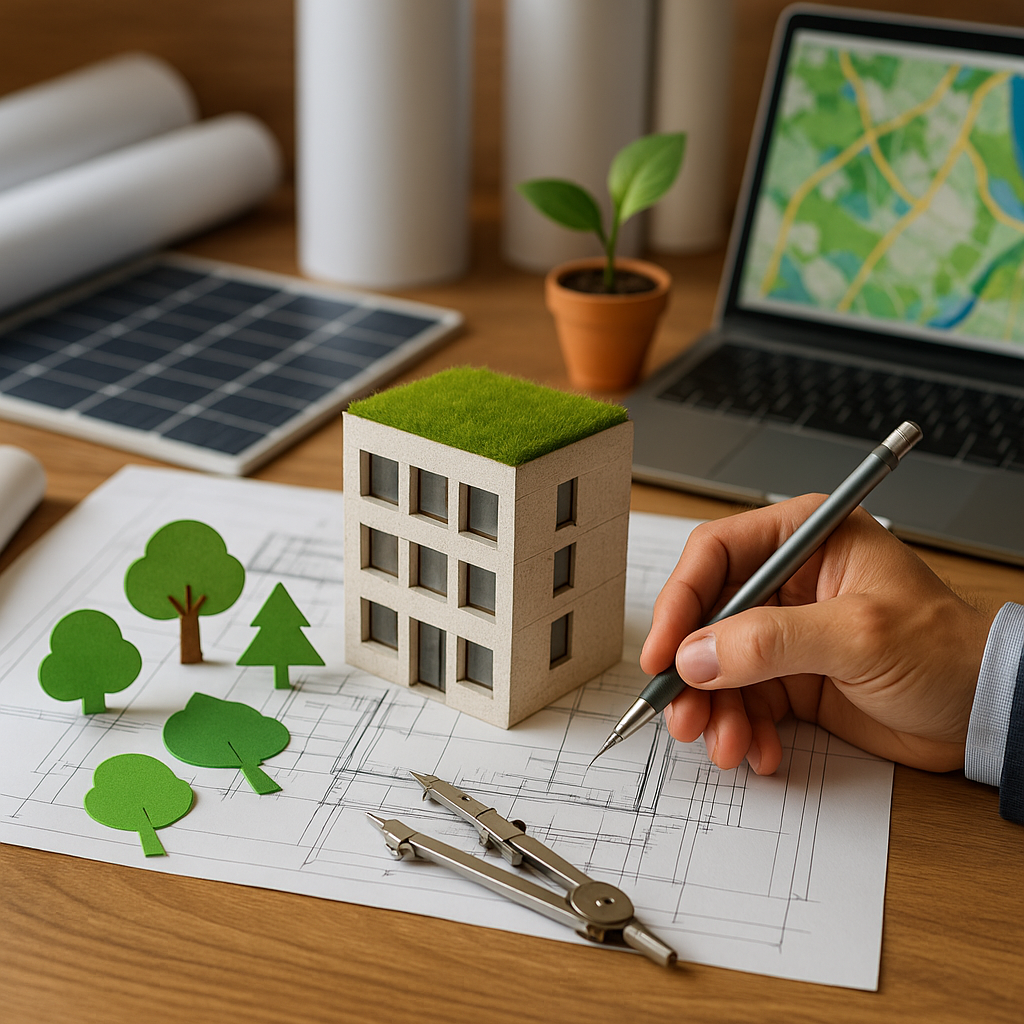
As cities expand and the demand for infrastructure rises, civil design must evolve to meet the dual challenge of innovation and environmental responsibility. The next generation of engineers faces a defining question: how can we build smarter, stronger, and faster while protecting the planet we depend on?
At EcoStruct Engineering & Management, our answer lies in harmonizing technology with sustainability. We believe that the future of civil design depends not only on what we build but also on how responsibly we build it. Every design decision from selecting materials to energy modeling has an environmental impact, and we aim to make that impact a positive one.
Green Materials and Low-Carbon Construction
One of the most pressing issues in civil design today is the carbon footprint of construction materials. Cement, steel, and glass staples of modern infrastructure are also major sources of carbon emissions. That’s why EcoStruct is leading the shift toward green and low-carbon materials that reduce environmental harm without compromising durability or cost efficiency.
We actively integrate:
- Recycled aggregates and industrial byproducts like fly ash and slag cement to reduce raw material use.
- Geopolymer concrete and fiber-reinforced composites for better performance with lower emissions.
- Timber-based hybrid systems for sustainable housing and small-scale structures.
By combining innovative material science with advanced design, we create projects that are both structurally sound and environmentally progressive.
Water-Efficient and Climate-Resilient Designs
Water is one of the most critical yet underappreciated elements in sustainable design. EcoStruct incorporates water-efficient systems that minimize waste, encourage recycling, and mitigate flooding risks. Our engineers design green drainage systems, permeable pavements, and rainwater harvesting structures that reduce stormwater runoff and replenish local water tables.
In coastal or flood-prone regions, our climate-resilient structures employ elevated foundations, storm-resistant materials, and erosion control measures. By planning for future climate risks, we ensure infrastructure longevity and community safety.
Digital Tools Empowering Sustainability
The digital transformation of engineering has made it possible to design with unprecedented precision. EcoStruct’s design teams use Building Information Modeling (BIM) and AutoCAD Civil 3D to visualize every detail before construction begins. These platforms enable us to analyze energy efficiency, material usage, and lifecycle costs ensuring sustainability is embedded in every phase of a project.
Through BIM-enabled simulations, we assess solar orientation, thermal comfort, and material energy performance, helping clients make data-driven decisions that save energy and money. Our GIS mapping technology further supports environmental planning by identifying sensitive ecosystems, optimizing site locations, and minimizing ecological disruption.
This digital integration transforms design from a static process into an intelligent, adaptive system one that constantly learns and improves with every project.
Collaboration for a Sustainable Tomorrow
EcoStruct believes that sustainability thrives through collaboration and knowledge-sharing. That’s why we work with universities, research institutes, and NGOs to advance the study of eco-engineering practices. Together, we develop design methodologies that not only meet current environmental standards but also set new benchmarks for the industry.
Our partnerships allow us to pilot experimental materials, apply emerging technologies like AI-driven life-cycle analysis, and expand our research into renewable infrastructure systems. These collaborations ensure that EcoStruct remains at the forefront of sustainable innovation while contributing to the global body of environmental engineering knowledge.
Social Sustainability and Women in Engineering
Sustainability isn’t only about protecting the planet it’s also about empowering people. At EcoStruct, we advocate for diversity and inclusion within engineering by promoting women’s leadership in sustainable design. Through our Women in Engineering Mentorship Program, we encourage young professionals to explore eco-conscious engineering careers and take on leadership roles in infrastructure development.
By nurturing diverse perspectives, we strengthen the creativity and empathy needed to solve global challenges. Our projects are a reflection of this belief designed not only for performance but also for the well-being of communities.
The Balance Between Innovation and Responsibility
Innovation drives progress, but without responsibility, it can lead to environmental and social harm. EcoStruct is committed to achieving balance leveraging modern technology to create infrastructure that enhances life while preserving nature.
For instance, our recent initiatives combine renewable energy systems, such as solar-integrated facades and geothermal heating, with intelligent monitoring platforms that track energy consumption in real time. This holistic approach ensures that every innovation serves both functional and environmental purposes.
Our philosophy aligns with the broader goals of the U.S. Infrastructure Investment and Jobs Act (IIJA) and the Department of Energy’s Clean Energy Initiatives, which emphasize sustainability as a cornerstone of national progress.
Designing for the Next Generation
Civil design today is about more than blueprints and concrete — it’s about creating a legacy of resilience and responsibility. The next generation of engineers will inherit a world facing extreme weather, resource scarcity, and rapid urbanization. Our job is to equip them with the tools, technologies, and values needed to design with conscience.
At EcoStruct Engineering & Management, we are proud to be part of that transformation. Every structure we design is a step toward a future where innovation and sustainability are not opposing forces but partners in progress.By embracing this balance, we build more than infrastructure we build trust, purpose, and a greener tomorrow.